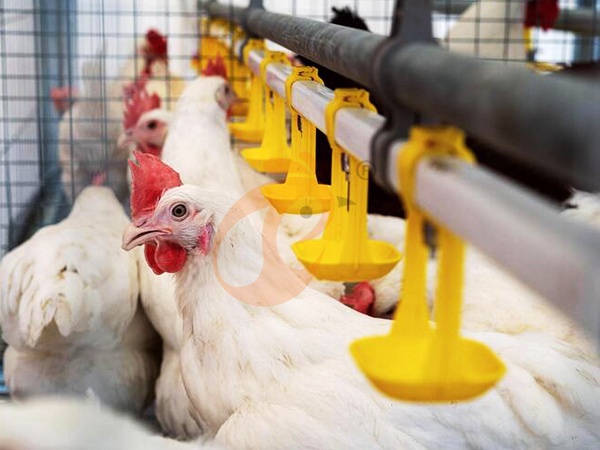
System Architecture Overview
Environmental Control System (ECS) deployment in poultry farming is structured as a layered engineering model consisting of sensing layer, control layer, execution layer, and monitoring interface.
Each layer operates under deterministic feedback loops to maintain stable internal barn conditions.
Market sourcing behavior shows repeated demand for ''poultry environmental control system price'', ''chicken house ventilation system cost'', and ''automatic poultry climate controller'' in procurement planning.
Data is for reference only.Swipe horizontally to view full table.
| Component Type | Quantity Per 10000 Birds | Unit Cost (USD) | Total Cost (USD) |
| Exhaust Fan Unit (130 cm) | 12 | 285 | 3420 |
| Cooling Pad System (m²) | 42 | 19 | 798 |
| Air Inlet System (Unit) | 18 | 36 | 648 |
| Controller Unit (PLC) | 1 | 2200 | 2200 |
| Temperature Sensor (Unit) | 10 | 48 | 480 |
| Ammonia Sensor (Unit) | 6 | 165 | 990 |
| Heating Unit (Set) | 4 | 430 | 1720 |
System architecture efficiency is directly influenced by airflow resistance coefficient, sensor density distribution, and actuator response delay.
Industrial poultry installations prioritize redundancy design to prevent thermal instability during peak load conditions.
The poultry ventilation system cost is primarily determined by airflow displacement requirements, static pressure design, and motor efficiency classification.
Structural scaling increases cost due to reinforced electrical infrastructure and expanded duct distribution networks.
Procurement analysis consistently reflects demand for poultry ventilation system cost comparison, broiler house cooling system pricing, and livestock airflow system investment range.
Data is for reference only.Swipe horizontally to view full table.
| Farm Capacity (Birds) | House Area (M²) | Airflow Requirement (M³/H) | System Cost (USD) |
| 5000 | 520 | 45000 | 9800 |
| 10000 | 920 | 90000 | 11950 |
| 20000 | 1850 | 180000 | 18600 |
| 50000 | 4100 | 360000 | 34500 |
| 100000 | 8200 | 720000 | 62000 |
Airflow engineering design requires precise balancing between inlet velocity and exhaust extraction rate.
Cost escalation is strongly correlated with ventilation redundancy index and emergency backup system integration.
Automatic Climate Control System For Poultry House Integration
The automatic climate control system for poultry house operations utilizes distributed sensing arrays combined with centralized decision algorithms.
Real-time adjustments regulate temperature deviation thresholds within defined biological tolerance limits.
Market demand consistently highlights poultry house automatic control system cost, smart livestock environmental system pricing, and IoT poultry farm controller investment.
Data is for reference only.Swipe horizontally to view full table.
| Control Function | Response Time (Second) | Accuracy Range (°C / %RH / PPM) | Unit Cost (USD) |
| Temperature Regulation | 5 | ±0.5 | 420 |
| Humidity Control | 6 | ±2% | 390 |
| Ammonia Detection | 4 | ±3 ppm | 165 |
| Ventilation Adjustment | 3 | ±5% airflow | 280 |
| Lighting Synchronization | 2 | ±1 min cycle | 210 |
Control logic architecture prioritizes predictive response modeling over reactive adjustment mechanisms.
System behavior improves flock survival rate stability during thermal stress cycles.
Temperature And Humidity Regulation Engineering
Thermal-hygrometric regulation in poultry houses is governed by psychrometric equilibrium principles, where moisture content and air
enthalpy are continuously adjusted through evaporative and mechanical systems.
Industry procurement queries frequently include poultry humidity control system price, barn temperature sensor network cost, and
livestock air quality monitoring system.
Data is for reference only.Swipe horizontally to view full table.
| Sensor Type | Measurement Range | Accuracy Level | Price (USD) |
| Temperature Sensor | -20 to 80°C | ±0.5°C | 42 |
| Humidity Sensor | 0 to 100% RH | ±2% RH | 55 |
| CO2 Sensor | 0 to 5000 PPM | ±50 PPM | 180 |
| Air Pressure Sensor | 0 to 500 PA | ±1.5% | 95 |
| Ammonia Sensor | 0 to 100 PPM | ±3 PPM | 165 |
Sensor fusion modeling enables cross-validation between thermal and chemical environmental variables.
System stability accuracy improves under high-density poultry conditions.
Fan system economics define operational efficiency in poultry ventilation networks.
Blade diameter, motor torque, and aerodynamic efficiency directly influence energy consumption and airflow uniformity.
Procurement references frequently include poultry exhaust fan price per unit, industrial ventilation fan airflow cost, and livestock house fan system specification.
Data is for reference only.Swipe horizontally to view full table.
| Fan Diameter (CM) | Airflow Capacity (M³/H) | Power Consumption (W) | Unit Price (USD) |
| 100 | 18000 | 370 | 210 |
| 130 | 22500 | 550 | 285 |
| 140 | 25000 | 750 | 340 |
| 150 | 28500 | 900 | 410 |
| 180 | 35000 | 1200 | 520 |
Energy-to-airflow conversion ratio remains the primary metric for evaluating poultry ventilation efficiency across industrial farming
operations.
Sensor Network Pricing Structure
Sensor network architecture determines real-time data acquisition capability within poultry environmental monitoring systems.
Distributed sensor grids improve predictive environmental stabilization accuracy.
Common procurement references include poultry farm sensor system cost, IoT livestock monitoring pricing, and industrial environmental sensor network cost.
Data is for reference only.Swipe horizontally to view full table.
| Sensor Network Type | Node Quantity | Communication Protocol | System Cost (USD) |
| Basic Wired Network | 12 | RS485 | 850 |
| Hybrid Sensor Network | 24 | CAN + wired | 1450 |
| IoT Wireless Network | 48 | WiFi + cloud | 3200 |
| AI Integrated Network | 64 | Edge + cloud | 5600 |
| Industrial Redundant Network | 96 | Dual channel fiber | 8800 |
Data transmission latency reduction significantly enhances environmental response synchronization.
System performance improves under high-density poultry production systems.
Market Price Trend Analysis
ECS pricing dynamics are influenced by semiconductor availability, energy tariffs, and automation penetration rates in agricultural
engineering markets.
Industry sourcing patterns regularly include poultry environmental system price trend, automated farm control cost evolution, and smart
livestock system investment comparison.
Data is for reference only.Swipe horizontally to view full table.
| Year | Average System Cost (USD) | Energy Index (kWh per 10000 Birds) | Automation Level Index |
| 2020 | 45000 | 2800 | 35 |
| 2021 | 48000 | 2950 | 40 |
| 2022 | 52000 | 3100 | 48 |
| 2023 | 56000 | 3300 | 55 |
| 2024 | 60000 | 3450 | 63 |
Cost escalation correlates strongly with precision livestock farming adoption.
System integration expands with AI-based environmental control deployment.
Recommended System Packages
Standardized ECS configurations enable scalable deployment across poultry farm sizes with predefined engineering performance
thresholds.
Frequent procurement expressions include poultry farm turnkey system cost, integrated ventilation package price, and smart poultry
housing system investment.
Data is for reference only.Swipe horizontally to view full table.
| Package Level | Target Capacity (Birds) | Included Components Count | Package Price (USD) |
| Starter Level | 5000 | 24 | 9500 |
| Standard Level | 10000 | 38 | 12200 |
| Advanced Level | 20000 | 65 | 19800 |
| Smart Level | 50000 | 120 | 36500 |
| Industrial Level | 100000 | 240 | 68000 |
System modularity enables incremental expansion without redesign of core ventilation systems.
Control architecture remains scalable across multiple poultry production environments.
Maintenance Lifecycle Cost Model
Lifecycle expenditure includes preventive maintenance, sensor calibration cycles, motor replacement intervals, and control system
firmware upgrades.
Annual maintenance ratio ranges between 6% and 11% of initial installation value depending on operational intensity and climatic
conditions.
Predictive maintenance algorithms reduce system downtime by analyzing vibration patterns, airflow degradation curves, and sensor drift indicators.
Frequently Asked Questions
Q1: What determines poultry environmental control system pricing variation?
System pricing is determined by airflow capacity, sensor density, automation level, and redundancy design.
A 10000-bird configuration typically remains near 11950 USD, while 100000-bird systems exceed 62000 USD due to expanded ventilation infrastructure.
Q2: How does poultry ventilation system cost impact farm performance?
Ventilation investment directly influences ammonia removal efficiency and thermal stability.
Controlled airflow systems reduce mortality risk and stabilize feed conversion ratio within measurable operational ranges.
Q3: What defines automatic climate control system for poultry house efficiency?
Efficiency is defined by response time under 5 seconds, temperature accuracy within ±0.5°C, and multi-node sensor synchronization across distributed barn zones.
Taiyu (HK) Group - One Of China Biggest Environmental Control System Manufacturer
Poultry environmental control system integrates ventilation automation, thermal regulation, ammonia management, and precision sensor-driven climate stabilization designed for industrial poultry house performance optimization.
Factory direct supply enables cost-controlled production of poultry ventilation system components with standardized manufacturing lines and global logistics distribution efficiency.
Global poultry equipment supply chain provides advanced cooling pad systems, exhaust fans, controllers, and full environmental automation modules for commercial poultry farms.
Poultry cage integrated engineering solutions align structural housing systems with automated environmental control technology for optimized bird density and growth performance stability.
Turn-key engineering services deliver complete poultry house environmental system including design, installation, commissioning, and operational training for industrial farming projects.